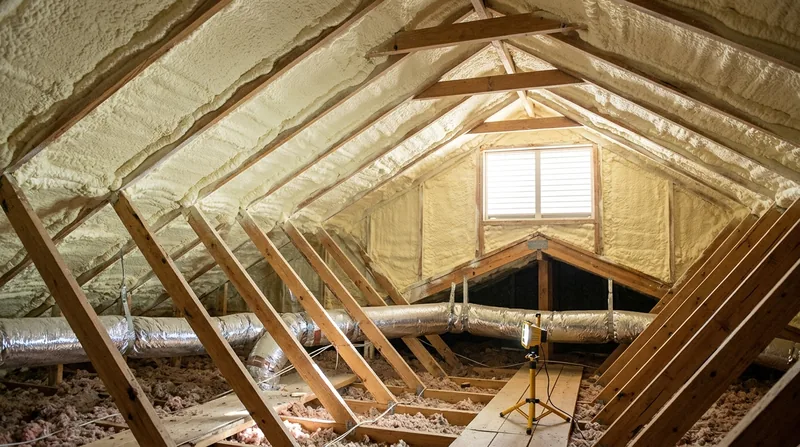




Open cell spray foam insulation in Killeen fills the vented attics and wall cavities of the post-1980s subdivisions that dominate Bell County, sealing the gaps that let humid summer air sneak past ceiling framing year-round. Killeen's single-story and two-story homes were built for military families, many now rental properties with ductwork running through hot attics where fiberglass has settled and compressed over decades. Open cell foam expands to fill every cavity and penetration, stops air leakage that fiberglass misses, and costs less than closed cell while delivering the air-sealing performance that matters in a long cooling season. We spray open cell foam across Killeen, Harker Heights, Nolanville, and the surrounding Bell and Coryell County towns, and we help homeowners and landlords understand when open cell is the right choice and when closed cell or blown-in insulation makes better sense for the job.
Why Open Cell Spray Foam Matters in Killeen's Hot, Humid Attics
Killeen's climate zone is 2A: hot and humid, with a cooling season that runs nine months a year and drives air conditioners hard from April through October. The problem is not heat loss in winter, it is humid outside air leaking into conditioned space through ceiling gaps, ductwork penetrations, and the gaps around electrical boxes and HVAC chases that fiberglass batts cannot seal. Open cell foam stops that air leakage, reduces the load on the cooling system, and keeps humidity out of the attic and the living space below.
- Open cell foam expands to fill every gap in the attic floor and rafter cavity that fiberglass misses.
- The expanding foam seals around ductwork, electrical penetrations, and rim joists where humid air finds entry points.
- Lower R-value per inch than closed cell, but sufficient for attic top-ups and wall cavities in Central Texas climate.
- Costs roughly 30 to 40 percent less than closed cell foam per board foot, making it the price-friendly choice for homeowners on budget.
- Allows the attic to breathe if vented properly, and does not trap moisture in the framing like an unvented sealed attic can if the air barrier is not perfect.
Killeen's older rental stock and military-era homes often have attics where the original fiberglass has compressed to R-3 or R-4 per inch, and open cell foam applied over the top raises the effective R-value while sealing the air leaks that drive up cooling bills.
Local example: A 1990s ranch home in Killeen with 2x6 rafter bays and vented attic can be topped with 5.5 inches of open cell foam (R-19 to R-21), sealed at the ceiling plane, for less cost than the closed cell alternative, and the attic stays vented so no thermal barrier is required by code.
For more on how attic insulation works in Killeen's climate, see our guide to attic spray foam insulation.
For detailed information on contractor registration and permitting requirements in your city, contact your local building department or visit the Texas Department of Licensing and Regulation website to understand what applies at your address.
How We Spray Open Cell Foam in Killeen Attics and Walls
Open cell foam is sprayed from a heated, pressurized rig, and the two-component liquid expands on contact to fill cavities and seal gaps. The process takes one to two days depending on job size, and we control the thickness, the ratio of resin to catalyst, and the drum temperature to ensure proper expansion and cure. Mechanical ventilation runs during application and for twenty-four to forty-eight hours after, so the isocyanate fumes can escape before the space is re-entered.
- We inspect the attic or wall cavity and identify gaps, ductwork, and electrical penetrations that need sealing.
- We set up containment and mechanical ventilation to pull fumes out of the space during and after the spray.
- We spray the foam in multiple passes, building thickness in layers to ensure even coverage and proper expansion.
- We measure the final thickness with a depth gauge and document the R-value and board-foot coverage on your invoice.
- We allow the foam to cure fully before we seal the space and remove ventilation, typically forty-eight hours in Killeen's warm climate.
The job is complete when the foam is cured, the attic is re-entry safe, and you have a written record of what was sprayed, where, and to what thickness and R-value.
Example: A two-story home in Harker Heights with a vented attic and compressed fiberglass takes two days to spray 5.5 inches of open cell foam over the ceiling plane, seal the rim joists, and spray around the HVAC chase and return-air plenum. The homeowner sees the thickness documented, the R-value calculated, and a clear before-and-after of what was sealed.
If your attic has failed foam, wet insulation, or contaminated batts, we can handle the removal first. Learn more about insulation removal in Killeen.
Open Cell Spray Foam Methods and When to Use Each
| Approach | Description | Best for |
|---|---|---|
| Vented attic top-up | Open cell foam sprayed over existing fiberglass on the attic floor, sealing gaps and raising R-value without disturbing the vented space. | 1990s and 2000s homes in Killeen with compressed batts and air leaks, where attic ventilation is intact and desired. |
| Wall cavity retrofit | Injection foam or cavity spray into closed wall cavities of pre-1980 homes without removing drywall or siding. | Older Temple and Belton homes where fiberglass was never installed or has settled, and demolition is not an option. |
| Rim joist and band joist sealing | Open cell foam sprayed into the band joist cavity at the rim of the foundation, stopping air leakage from the crawl space or exterior. | Slab-on-grade homes in Killeen where the band joist is exposed in the basement or garage, and cold drafts enter at the rim. |
| Full attic encapsulation (sealed rafter) | Open cell or closed cell foam sprayed on the underside of the roof deck, creating a conditioned attic space with no venting required. | New construction or major attic renovations where ductwork or equipment is located in the attic and must be conditioned. |
Open Cell Spray Foam Insulation Cost in Killeen: What to Expect
Open cell spray foam starts at $0.55 to $0.75 per board foot in Killeen, depending on the size and complexity of the job, access to the attic or wall cavity, and whether existing insulation must be removed first. A typical attic top-up of 5.5 inches over 1,500 square feet runs 8,000 to 9,000 board feet and costs between $4,400 and $6,750 before any site-specific factors. The price is driven by the board footage sprayed, not by the square footage of the house, so a well-insulated attic with tight cavities uses less foam than an open rafter bay or a home with extensive air gaps.
Factors that move the cost up or down include the following: access to the attic (a finished second story or tight crawl space adds time and cost), the condition of existing insulation (if we remove flattened fiberglass or contaminated batts first, that labor is added), the shape and number of rafter bays (irregular framing or many penetrations require more care and more foam), and the distance from Killeen to your location (we serve Harker Heights, Nolanville, Copperas Cove, Belton, and other surrounding towns with no separate travel charge, but jobs in outlying areas of Coryell County may carry a trip fee). Getting two or three estimates from local contractors is always smart, so you can compare the board footage, the R-value, and the thickness that each contractor proposes.
For a detailed look at pricing across all our services, visit our pricing overview.
What to Look for When Hiring a Spray Foam Insulation Contractor Near Me in Killeen
Spray foam insulation is a two-part chemical application that must be mixed, sprayed, and cured correctly, or the foam will fail to expand properly, will off-gas excessively, or will develop an odor that lingers for months. The difference between a careful installer and a careless one shows up in the details: an estimate that specifies the R-value and thickness you are paying for, mechanical ventilation running during and after the spray, a stated re-entry window of twenty-four to forty-eight hours, and insurance that can be verified before work begins.
When you call a spray foam contractor in Killeen or Harker Heights, ask for the following:
- A written estimate that lists the R-value, the board footage, and the thickness in inches that will be sprayed, not a vague price per square foot.
- Proof of liability and workers' compensation insurance, and confirmation that the contractor is fully insured for spray foam work.
- A clear statement of what happens during and after the spray: how long ventilation runs, when the space can be re-entered, and what odor is normal.
- References from at least two or three recent jobs in Killeen or a nearby town, and permission to call them and ask about the quality of the work and the installer's follow-up.
- An explanation of what permits apply at your address and whether the contractor helps you navigate local requirements or leaves that to you.
- A confirmation that the contractor will inspect the substrate before spraying, and will walk away if the surface is wet, contaminated, or not suitable for foam.
Be wary of any contractor who promises immediate re-entry, quotes a price far below the local market rate without seeing the job, cannot provide insurance details, or pressures you to sign before you have had time to compare estimates. The local independent shop with a local address and local plates is a good starting point, and you can verify our insurance and ask for references by calling us at (254) 312-9738 or visiting our contact page.
Open Cell Spray Foam Insulation in Killeen: Pricing Guide
| Service | Price | Details |
|---|---|---|
| Attic top-up (open cell) | Starting at $0.55/board ft | Foam sprayed over existing insulation on attic floor; cost rises with board footage and access difficulty to the attic space |
| Wall cavity retrofit (injection or spray) | Starting at $0.65/board ft | Closed walls of pre-1980 homes filled without demolition; price reflects drilling access points and the complexity of the cavity layout |
| Rim joist and band joist sealing | Starting at $3.50/linear ft | Open cell foam around the foundation rim; total cost depends on the perimeter length and whether access requires crawl space or basement entry |
| Insulation removal plus foam spray | On estimate | Removal labor and disposal added to foam cost; final price depends on the volume and type of existing insulation to be removed |
| Travel within Killeen service area | Included | No separate call-out or mileage fee for jobs in Killeen, Harker Heights, Nolanville, Copperas Cove, Belton, and surrounding towns |
| Free estimate | No charge | Response within 24 hours at (254) 312-9738; written estimate with R-value and thickness specs, no obligation to book |
Indicative pricing, the exact cost depends on square footage, finish, and site access. Free personalized estimate within 24h at (254) 312-9738.


