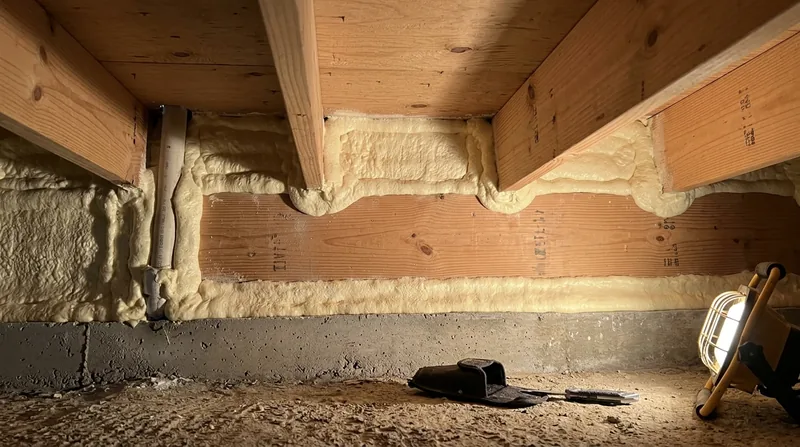




Closed cell spray foam insulation in Killeen delivers a rigid moisture barrier and air seal that stands up to Central Texas humidity and the slab-on-grade foundation design that dominates this region. Killeen, Harker Heights, Nolanville, and Copperas Cove were built out with single and two-story homes from the 1980s onward, many now rental properties with ductwork running through vented attics that bleed conditioned air into the unconditioned space above. The long cooling season here pushes warm, humid outside air through every ceiling penetration and gap, driving up energy bills and making rooms that never quite cool down. Closed cell foam adds both the air seal and the moisture resistance that fiberglass and open cell cannot match in a humid climate. We have been installing spray foam and air sealing in Greater Killeen since 2012, and we understand the specific failure modes of this building stock.
Why Closed Cell Spray Foam Insulation Matters in Killeen's Hot, Humid Climate
Killeen sits in IECC climate zone 2A, a hot and humid zone where the outdoor air in summer carries moisture that seeks every gap in the ceiling and attic floor. A standard fiberglass attic with air leaks around ductwork, electrical penetrations, and soffit vents allows that humid air to condense on the back side of the roof decking, rotting framing and driving mold growth. Open cell foam breathes and absorbs moisture, making it unsuitable for this climate unless paired with a separate vapor barrier. Closed cell foam creates a continuous air seal and a rigid moisture barrier in a single pass, stopping the humid air before it enters the attic and condensates on cold surfaces.
- We seal all penetrations and air leaks in the attic floor or rim band before applying the foam.
- Closed cell foam adds structural rigidity to rim and band joist areas, resisting the flex that allows air infiltration.
- The moisture barrier stops humid summer air from entering the attic, eliminating the condensation cycle that destroys fiberglass.
- Closed cell foam is denser and more water-resistant than open cell, making it the right choice for slab-on-grade homes where moisture pressure is constant.
- A sealed attic keeps ductwork cooler and reduces the strain on air conditioning systems running hard for six months a year.
These five factors combine to make closed cell spray foam the most cost-effective retrofit for the Killeen housing stock, especially in older rental properties and homes where the attic insulation has settled or failed.
Key info: Bell and Coryell counties experience peak cooling demand from May through September, with outdoor humidity regularly above 65 percent. A vented attic in Killeen loses more energy to moisture infiltration and duct loss than it would in a dry climate. Sealing the attic with closed cell foam reduces both cooling load and the risk of attic mold that drives remediation costs into the thousands.
For more detail on how sealed attics compare to vented ones in this region, see our page on attic spray foam insulation in Killeen.
How We Install Closed Cell Spray Foam Insulation in Killeen Homes and Buildings
Closed cell foam installation begins with a site assessment and a written estimate that specifies the R-value, thickness, and board footage we plan to apply. We then seal all air leaks, ductwork penetrations, and rim band gaps with caulk or foam backer rod before the spray begins. During installation, we control the spray pressure, nozzle distance, and pass thickness to achieve the manufacturer ratio and uniform density. Mechanical ventilation runs during application and cure, and we set a re-entry window of 24 to 48 hours before you occupy the space.
- We conduct a thorough walkthrough and measure all attic, wall, or rim band areas that will receive foam.
- We identify and seal air leaks, ductwork penetrations, and electrical chases with caulk or backer rod before spraying begins.
- We apply closed cell foam in controlled passes, maintaining the correct drum temperature and spray ratio per manufacturer specs.
- We run mechanical ventilation throughout the cure period to remove isocyanate vapors and ensure safe re-entry within 24 to 48 hours.
- We provide a written inspection report and a summary of R-value and thickness achieved at each location.
This methodical approach ensures that the foam bonds correctly, achieves the rated R-value, and does not off-gas or shrink after cure.
Example: A two-story home in Harker Heights with a vented attic and exposed ductwork receives 5.5 inches of closed cell foam (R-38) across the attic floor, plus 2 inches (R-14) around all rim band and band joist areas. The job takes one day, mechanical ventilation runs for eight hours, and the homeowner re-enters after 36 hours. The sealed attic and rim band eliminate air leaks that were pulling hot outside air through the band joist and soffit vents.
Learn more about air sealing around spray foam and why it is the foundation of every retrofit we perform.
Closed Cell Spray Foam Methods and Applications
| Approach | Description | Best for |
|---|---|---|
| Sealed attic deck | Closed cell foam sprayed directly onto the underside of the roof decking, creating an unvented, conditioned attic space. | Homes with ductwork in the attic, HVAC equipment in the attic, or poor attic ventilation due to blocked soffits or ridge vents. |
| Attic floor with rim band | Closed cell foam applied to the top of the attic floor joists plus a 2 to 4 inch band around the rim joist and band board. | Slab-on-grade homes in Killeen and Harker Heights where moisture infiltration through the rim band is the primary air leak and energy loss. |
| Wall cavity injection | Low-pressure closed cell foam injected into existing wall cavities through small holes drilled from the exterior or interior. | Pre-1980 homes in Temple and Belton with hollow walls and no insulation, or walls with settled fiberglass that no longer performs. |
| Metal building and garage | Closed cell foam sprayed to the underside of metal roof and wall panels, preventing condensation and moisture damage inside the building. | Metal shops, barndominiums, and garages in Coryell County and rural areas around Salado where steel condensates in humid summer air. |
| Crawl space walls | Closed cell foam applied to crawl space rim band, band joist, and foundation walls to create a moisture barrier and air seal. | Killeen homes with crawl spaces experiencing humidity, musty odors, or moisture infiltration from the outside air and groundwater. |
Each method is tailored to the specific failure mode and building design of the property. We assess the site and recommend the approach that delivers the best R-value and air seal for the climate and the occupancy.
Closed Cell Spray Foam Insulation Cost in Killeen: What to Expect
Closed cell spray foam in Killeen starts at approximately $1.20 per board foot, though the final price depends on several site-specific factors. A board foot is one square foot of material sprayed to a thickness of one inch. If you spray 1,000 square feet of attic floor to a depth of 5.5 inches, that is 5,500 board feet. Access, existing insulation that must be removed, the complexity of air sealing required, and the total square footage all move the cost up or down from that baseline.
- Small jobs, such as a rim band seal in a garage or a single-room wall cavity injection, typically run $800 to $1,500.
- An attic floor retrofit in a Killeen or Harker Heights home, 1,200 to 1,600 square feet, usually falls between $3,500 and $6,000 depending on depth and existing insulation.
- A sealed attic deck (roof underside) in a two-story home with full ductwork sealing can range from $5,500 to $9,000 or more.
- Metal building or barndominium insulation is priced by board foot and the complexity of the spray pattern, often $4,000 to $12,000 for a 1,500 to 2,500 square foot building.
Every job begins with a free, no-obligation written estimate that specifies the R-value, thickness, and board footage we plan to apply. We recommend getting two or three estimates from different contractors to compare not just price but the depth and detail of the specification. A vague estimate with no R-value and no thickness is a red flag. We respond to estimate requests within 24 hours at (254) 312-9738. For a detailed pricing breakdown by region and service type, visit our full pricing page.
What to Look for When Hiring a Closed Cell Spray Foam Insulation Contractor Near Me in Killeen
Closed cell spray foam is a technical installation, and the difference between a careful contractor and a careless one shows up weeks or months after the job is done. When you are evaluating spray foam contractors near you in Killeen, Belton, or anywhere in Greater Killeen, verify that the contractor is fully insured and can provide a current certificate of insurance naming you as an additional insured. Ask any contractor whether your city or county requires contractor registration before work begins, and confirm that they hold the registration your local building department requires. Get at least two written estimates that include the R-value, thickness, and board footage, not just a price per square foot.
- Verify that the contractor is fully insured and request a current certificate of insurance for your records.
- Ask your city or county building department what contractor registration or permits apply to spray foam insulation at your address, and confirm the contractor complies.
- Request written estimates that specify R-value, thickness in inches, and total board footage, never just a price per square foot.
- Ask the contractor what mechanical ventilation they will run during cure and what re-entry window they guarantee (24 to 48 hours is standard).
- Check references from recent jobs and ask those homeowners whether the contractor was reachable after the job and whether any odor or off-gassing issues arose.
- Ask whether the contractor removes existing insulation or other debris, or whether you are responsible for cleanup.
A contractor who answers these questions clearly and provides references is one you can trust. If a contractor promises immediate re-entry, offers no mechanical ventilation, or quotes a price far below market with no inspection, walk away.
Ready to move forward? Contact us for a free estimate or call (254) 312-9738 to discuss your project with a real spray foam installer who knows Killeen.
Closed Cell Spray Foam Insulation in Killeen: Pricing Guide
| Service | Price | Details |
|---|---|---|
| Attic floor retrofit | Starting at $1.20/board ft | Sealed attic floor, 1,200 to 1,600 sq ft, 4 to 6 inches depth, includes air sealing and existing insulation removal |
| Sealed attic deck | Starting at $1.20/board ft | Foam sprayed to roof underside, 1,000 to 1,800 sq ft, typically 5.5 to 7 inches, includes ductwork sealing and ventilation control |
| Rim band and crawl space | Starting at $1.20/board ft | Rim joist and band board seal, 300 to 600 linear feet, 2 to 4 inches depth, foundation wall moisture barrier included |
| Metal building or barndominium | Starting at $1.20/board ft | Roof and wall panels, 1,500 to 2,500 sq ft, 3 to 4 inches depth, condensation control and structural bracing included |
| Wall cavity injection retrofit | Starting at $1.20/board ft | Low-pressure injection into existing cavities, pre-1980 homes, 500 to 1,200 sq ft, includes drilling and patching |
| Travel and estimate | Free | No charge for estimates or travel within Killeen, Harker Heights, Nolanville, Copperas Cove, Belton, and surrounding areas |
Indicative pricing, the exact cost depends on square footage, finish, and site access. Free personalized estimate within 24h at (254) 312-9738.


