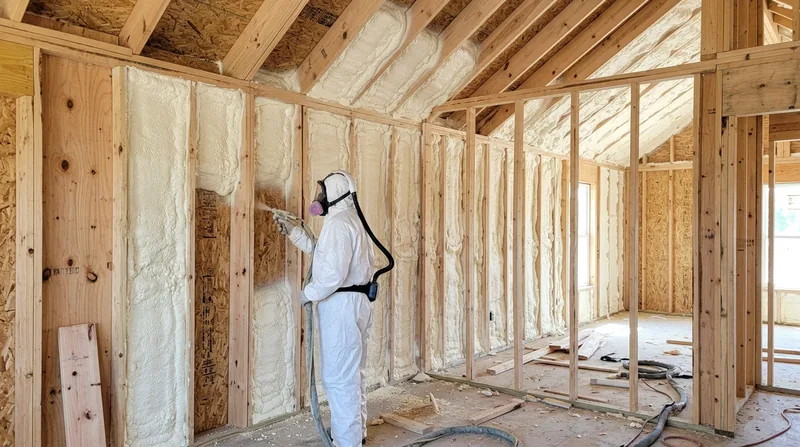




Commercial and new construction spray foam insulation in Killeen is rising alongside the steady wave of new residential and commercial builds across Greater Killeen, Harker Heights, Belton and Temple. New homes and commercial shells keep going up in master-planned communities and on raw land, and builders are choosing spray foam for its air sealing performance, energy code compliance and speed to closure before drywall and mechanical systems go in. Unlike retrofit work on older homes, new construction spray foam is part of the design from the start, sprayed into wall cavities and roof decks before the building envelope closes. We spray foam new construction walls and roof decks before drywall goes up, sized for the energy code that applies at your address, and we help builders and general contractors navigate the specifics of IECC compliance in Central Texas climate zone 2A. This page covers what the process looks like, what affects the cost, and how to verify a spray foam contractor for your project.
Why New Construction Spray Foam Matters in Killeen and Surrounding Areas
New construction in Killeen, Harker Heights, Nolanville and Copperas Cove is driven by military relocations, suburban growth and commercial expansion. The energy code that governs new construction in Texas is the International Energy Conservation Code (IECC) adopted by your city or county, and it sets minimum R-values and air leakage rates for walls, roof decks and foundation rim. Spray foam meets those requirements directly because it seals air leaks and provides continuous insulation with no gaps, no settling and no thermal bridging through studs. In the hot, humid Central Texas climate, an air-tight building envelope keeps conditioned air in and blocks humid outside air from infiltrating the attic or walls, which is the failure mode that dominates cooling-season bills across this region.
- We spray closed cell or open cell foam into wall cavities before drywall is hung, achieving the R-value and air sealing your energy code requires.
- We spray roof decks and sealed attics before mechanical equipment and ductwork are installed, ensuring no insulation gaps around penetrations.
- We work with general contractors and builders to pull permits and coordinate spray foam timing with framing, electrical rough-in and mechanical rough-in schedules.
- We provide written estimates that specify R-value, foam thickness and the code section that applies at your address.
New construction spray foam is a code-compliance and energy-performance decision made before the building closes, not a retrofit added years later.
Key info: Energy codes in Texas are set and enforced at the municipal level. Killeen, Harker Heights, Belton and Temple each adopt their own version of the IECC, and the R-value and air leakage requirements can differ. We confirm the code that applies to your project address and size the spray foam to meet it. For details on your city's specific energy code, contact your local building department or visit the International Code Council website for the code adoption status of your jurisdiction.
How We Handle New Construction Spray Foam in Killeen: The Process Step by Step
New construction spray foam follows a tight timeline because the building is framed and ready to be closed. We work with your general contractor or builder to coordinate our arrival after framing is complete and rough electrical and plumbing are done, but before drywall and HVAC ductwork go in. Our crew arrives with the equipment, material and safety gear needed to spray the foam in a controlled, well-ventilated environment. The job is staged and completed in one or two days depending on the size of the building, and mechanical ventilation runs during cure to manage VOC off-gassing. We provide a written estimate with R-value, thickness and code reference before work begins, and we handle the coordination with your builder's schedule.
- We review your building plans and confirm the energy code that applies to your project address and the R-value required for walls, roof decks and rim.
- We schedule our spray date to fit between framing completion and drywall or mechanical rough-in, coordinating with your general contractor and other trades.
- We set up temporary mechanical ventilation in the building to exhaust VOCs during foam cure and establish a 24 to 48 hour re-entry window.
- We spray the foam to the specified thickness in a single or two-day mobilization, with crew on site managing drum temperature, material ratio and pass thickness to code and manufacturer spec.
- We provide a signed work completion report and are available for any follow-up questions as the build moves forward.
The result is a fully air-sealed, code-compliant building envelope that is ready for drywall and mechanical systems on schedule.
Example: A 5,000 square foot commercial office shell in Killeen requires R-15 continuous insulation on the exterior wall and R-25 on the roof deck under the current IECC zone 2A code. We spray closed cell foam at 2.5 inches on walls (R-15) and 4 inches on the roof deck (R-25), completing the work in two days with mechanical ventilation running during cure. The builder schedules drywall and mechanical work to follow, and the building is on schedule for delivery.
New Construction Spray Foam Methods and Approaches
| Approach | Description | Best For |
|---|---|---|
| Closed Cell Spray Foam | High-density foam with closed cellular structure, R-6 per inch, vapor barrier properties, minimal air permeability. | Roof decks, sealed attics, metal buildings, walls in humid climates where vapor control is critical. |
| Open Cell Spray Foam | Lower-density foam with open cellular structure, R-3.6 per inch, air sealing without vapor barrier, lower material cost. | Interior walls in new construction where vapor permeability is acceptable and cost is a driver. |
| Rim and Band Joist Sealing | Spray foam applied to the rim board and band joist to seal the slab-on-grade perimeter and block outside air infiltration. | New slab-on-grade construction in Killeen, where the rim is the primary air leakage path into the conditioned space. |
| Roof Deck Sealing | Spray foam applied directly to the roof sheathing or decking to create a sealed, insulated roof assembly without a vented attic. | New commercial buildings, metal buildings and residential designs where a vented attic is not desired. |
Each approach is selected based on the building type, the energy code requirement and the climate. In Central Texas zone 2A, closed cell foam on roof decks and rim joists is the standard because it provides vapor control in the hot, humid summer when outside air wants to push moisture into the building.
Commercial and New Construction Spray Foam Cost in Killeen: What to Expect
Cost for new construction spray foam depends on the building size, the R-value required by code, the foam type (closed or open cell), roof and wall area, and access for equipment. A free commercial estimate is the starting point and gives you a firm price once we confirm the code requirement and measure the square footage. Most new construction spray foam projects in Killeen range from $1.50 to $3.50 per board foot installed, depending on foam type and thickness, plus any site-specific factors like building height, roof pitch complexity or difficult access. A 5,000 square foot building with R-15 walls and R-25 roof typically runs $8,000 to $15,000 for closed cell foam, but the only accurate number is one from an on-site estimate.
Getting a free estimate is the smart move because it lets you compare apples to apples: ask any contractor for R-value, thickness, foam type and the code section they are meeting. Builders and general contractors often get two or three estimates to lock in the best price and confirm the timeline fits the build schedule. Call us at (254) 312-9738 for a free commercial estimate with no obligation, and we will respond within 24 hours.
What to Look for When Hiring a Spray Foam Contractor Near Killeen
Choosing a spray foam contractor for new construction is a decision that affects code compliance, energy performance and the schedule of the entire project. You want a contractor who understands the energy code, can coordinate with your builder, provides written estimates with R-value and thickness, and shows up on time. The contractor should be fully insured and able to produce a certificate of insurance for your builder's records. Ask any contractor to confirm they are registered with the city or county where the work is happening, because contractor registration requirements vary from Killeen to Temple to Belton, and there is no reciprocity between Texas cities. References from other builders or general contractors in the area are worth a phone call, and a contractor who can show you past new construction projects is a good sign.
- Verify that the contractor is fully insured and ask to see a current certificate of insurance listing your builder as the certificate holder.
- Confirm that the contractor is registered with your city or county building department, and ask to see proof of that registration before signing a contract.
- Request a written estimate that includes R-value, foam thickness, the code section being met and the foam type (closed or open cell).
- Ask for references from other builders or general contractors who have used the same contractor on new construction projects in Killeen, Harker Heights or Belton.
- Confirm the contractor's timeline for scheduling and completion, and ensure it aligns with your build schedule and mechanical rough-in dates.
A contractor who can walk you through the code requirement, provide a clear written estimate and coordinate seamlessly with your builder is the one to call. Contact us at (254) 312-9738 for a free commercial estimate, and we will help you understand what applies at your project address and what the cost will be.
Commercial & New Construction Spray Foam in Killeen: Pricing Guide
| Service | Price | Details |
|---|---|---|
| Free Commercial Estimate | Free | On-site measurement, code review, R-value and thickness specification, no obligation to proceed |
| New Construction Walls (Open Cell) | Starting at $1.50/board foot | Interior wall cavities, R-value 3.6 per inch, labor and material included, schedule-dependent |
| New Construction Walls (Closed Cell) | Starting at $2.50/board foot | Exterior or sealed walls, R-value 6 per inch, vapor control included, code-compliant thickness |
| Roof Decks and Sealed Attics | Starting at $2.75/board foot | Closed cell foam, R-25 typical, mechanical ventilation during cure, 24-48 hour re-entry window |
| Rim Joist and Band Joist Sealing | Starting at $2.00/board foot | Slab-on-grade perimeter, closed cell foam, air sealing and insulation, typical 100-200 board feet |
| Travel and Mobilization | Included | No separate mileage fee in Killeen, Harker Heights, Belton, Temple and surrounding service areas |
Indicative pricing, the exact cost depends on square footage, finish, and site access. Free personalized estimate within 24h at (254) 312-9738.


